
The Fey Lords
Hope and Providence in the Deaths of Théoden and Denethor

The Return of the King opens in the valley of death. We left The Two Towers with a sense of hopelessness: Frodo is unconscious (which Sam first interpreted as death), and Sam is left in the darkness, separated from his master, lamenting that he “never really had any hope.”1 When we return to our heroes on the other side of the Anduin, we find Frodo and Sam’s experience with death and hopelessness has developed into the very atmosphere of Book V.
Gandalf and Pippin arrive at Minas Tirith, and we are promptly introduced to Denethor son of Ecthelion, Lord and Steward of Minas Tirith. Denethor reminds Pippin of both Aragorn and Gandalf,2 but it is Théoden King of Rohan with whom the text most deeply draws a comparison.
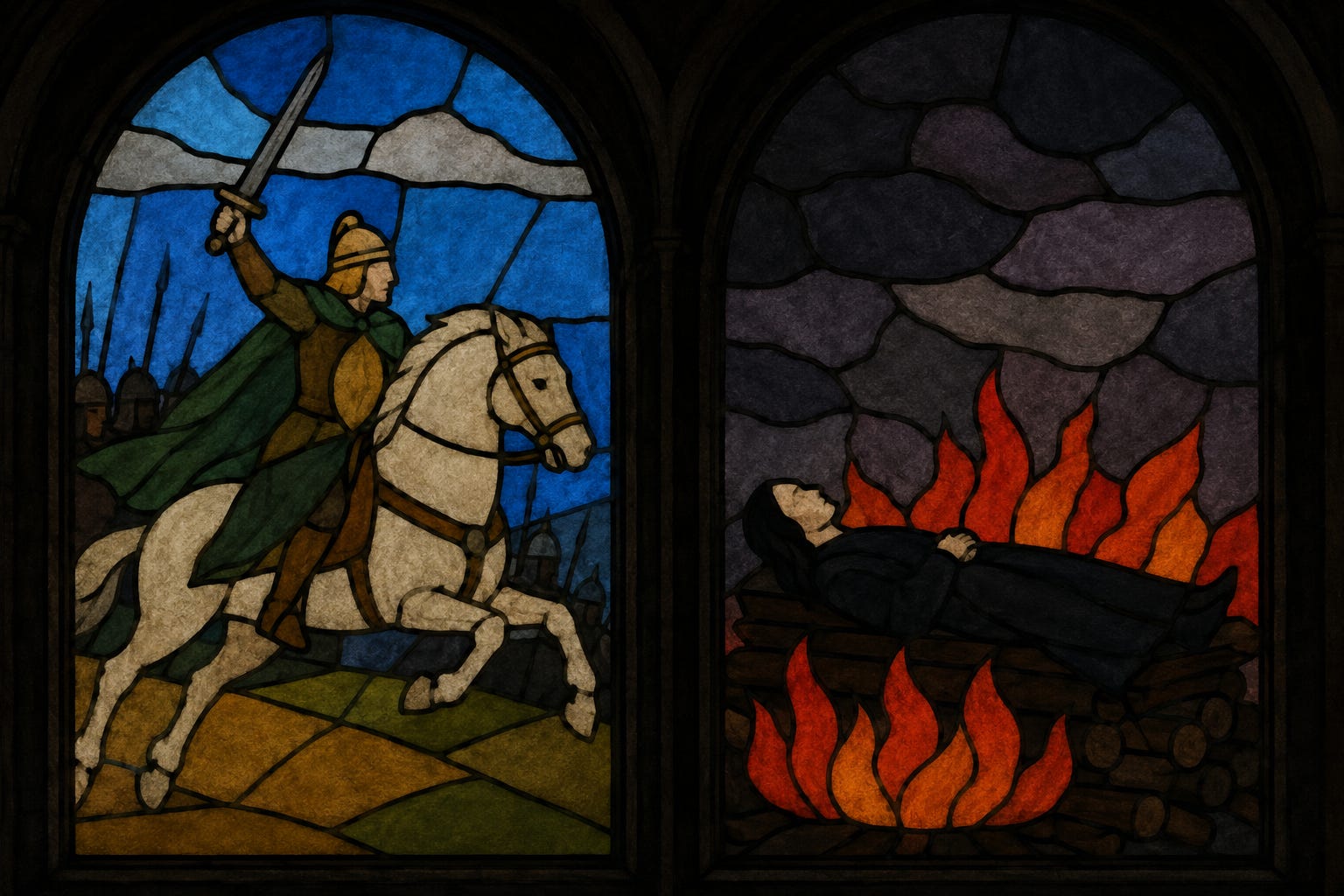
We meet both lords in despair and need. Both lost a son - the expected heir to his house - near a river and at the hand of Saruman, within the same twenty-four hours. In the wake of their grief and darkness, both mistrust the surviving heir, find their kingdoms narrowing under encroaching shadow, and oppose the counsel of Gandalf. Both accept the sworn service of hobbits: Pippin pledges his sword to Denethor, and Merry pledges his sword to Théoden.3 Both have sat long “in shadows and trusted to twisted tales and crooked promptings,” and greet Gandalf as a woeful, grey herald.4 Théoden surrendered his judgment to Wormtongue and Denethor exalted his judgment through his dangerous seeing stone. Consequently, Théoden believes too little of his own strength, and Denethor believes too much of it.
Their parallel descents into darkness reveal two radically different responses to providence: Denethor attempts to possess the future, while Théoden faithfully exhausts himself for a future he will not see. Gandalf uses Théoden as a contrasting figure for Pippin’s introduction to Denethor:
Théoden is a kindly old man. Denethor is of another sort, proud and subtle, a man of far greater lineage and power, though he is not called a king.5
Despite Denethor’s greater lineage, he lacks a humility of spirit and countenance that lends itself to kindness. He is stubborn and, despite all his wisdom and knowledge, is hardened with pride. Unlike his portrayal in Jackson’s films, Denethor is a truly great man, able to stand before Gandalf unblinking, kingly as Aragorn. Perhaps his greatness became his downfall. He has grown accustomed to seeing farther and enduring more than other men. Why submit his judgment to counsel? Why stake Gondor upon a hope he cannot verify when he can rely upon his own sight and strength?
Unlike Denethor, Théoden rejects the despair into which he fell. He hearkens to and trusts Gandalf’s counsel.6 He calls his surviving heir back to his side.7 He puts the good of his kingdom over his personal despair and grief.8
These matters come to a head in the siege of Minas Tirith. Faramir lies unconscious in bed. Denethor, who had maintained the countenance of a warrior through sheer force of will, breaks at the deathbed of his son.9 Overcome with grief and remorse, he “grew old before [Pippin’s] eyes,” an inversion of Théoden’s transformation which many beheld in Edoras.10
Thereafter Denethor’s grief hardens into despair, and his despair passes into madness. He becomes what Théoden prophesied would have been his own end, had he been held longer in Wormtongue’s dark counsel: “Your leechcraft ere long would have had me walking on all fours like a beast.”11 Even so, see how he responds when messengers call him to command the burning city:
‘Why? Why do the fools fly?’ said Denethor. ‘Better to burn sooner than late, for burn we must. Go back to your bonfire! And I? I will go now to my pyre. To my pyre! No tomb for Denethor and Faramir. No tomb! No long slow sleep of death embalmed. We will burn like heathen kings before ever a ship sailed hither from the West. The West has failed. Go back and burn!’12
Denethor then announces Faramir’s death (prematurely), releases Pippin from his service, and leads a funeral procession to Rath Dínen, the Silent Street and holding place of the dead, to burn himself and his son alive.13 It is no wonder, then, that Pippin twice calls him a “madman” as he flees to Gandalf for help. The hobbit sums up the matter well to Beregond: “The Lord of the City, Beregond, has fallen before his city is taken. He is fey and dangerous.”14
“Fey” comes from the Old English fæge, meaning “doomed” or “appointed to die.” In older literature (and certainly in Tolkien’s usage), it points to a peculiar state that comes with a conviction of inescapable death. One who truly believes his end has come may be described as fey. This mood falls upon several figures in Tolkien’s legendarium, such as Fingolfin and Fëanor, and here it is ascribed to Denethor, who lays himself and his son, still living, upon the funeral pyre.
The difference between Denethor and Théoden is not their experience of grief and darkness. Their contexts are remarkably similar. Théoden knew despair no less than Denethor. When the Rohirrim arrived at Minas Tirith, Merry took note of Théoden’s apparent hesitation:
The City was now nearer. A smell of burning was in the air and a very shadow of death. The horses were uneasy. But the king sat upon Snowmane, motionless, gazing upon the agony of Minas Tirith, as if stricken suddenly by anguish, or by dread. He seemed to shrink down, cowed by age. Merry himself felt as if a great weight of horror and doubt had settled on him. His heart beat slowly. Time seemed poised in uncertainty. They were too late! Too late was worse than never! Perhaps Théoden would quail, bow his old head, turn, slink away to hide in the hills.15
Théoden had a measure of anguish and regret no less than Denethor. Yet because Théoden had humbled himself, received counsel, and resumed the duties of his office, his anguish issues in a radically different end. At the sound of Mordor’s devices blasting open the Great Gate of the city, Théoden sprang erect. While Denethor fell fey upon his tomb, Théoden rose fey upon his horse, “tall and proud.” He led the charge and burst the great horn with a sounding blast, just as Boromir’s horn was broken. Denethor heard the cleaved horn as a sign of loss, but Théoden turns his own into a summons to courage.
Whereas Denethor is said to have become old before Pippin’s eyes, Théoden is cast in youthful terms - twice springing, unpassed in speed as he flies into battle, and shouting clearer than any mortal voice those present had heard before. In that moment, Tolkien compares him to Oromë (whose name the elves interpreted as “Horn-blowing” or “Sound of Horns”), a Vala who was known for his great wrath as a huntsman of Morgoth’s foul beasts. And so Tolkien says, as Théoden and his riders trod upon the orcs, that “the hoofs of wrath rode over them.” And even to the sun was Théoden likened, golden shield beaming, all green returning to the fields as he raced over the grass.16
Both men believe that death is near. What distinguished these two lords was their decisions when the end was surely come. In Denethor, the fey mood expresses itself as despair and self-destruction; in Théoden, it becomes selfless courage:
My body is broken. I go to my fathers. And even in their mighty company I shall not now be ashamed. I felled the black serpent.17
Of Denethor’s end, his final words to Gandalf may be the most enlightening:
‘I would have things as they were in all the days of my life,’ answered Denethor, ‘and in the days of my longfathers before me: to be the Lord of this City in peace, and leave my chair to a son after me, who would be his own master and no wizard’s pupil. But if doom denies this to me, then I will have naught: neither life diminished, nor love halved, nor honour abated.’18
Théoden also lamented his denied peace, but responded quite differently:
Slowly Théoden sat down again, as if weariness still struggled to master him against the will of Gandalf. He turned and looked at his great house. ‘Alas!’ he said, ‘that these evil days should be mine, and should come in my old age instead of that peace which I have earned. Alas for Boromir the brave! The young perish and the old linger, withering.’ He clutched his knees with his wrinkled hands….
‘Will you not take the sword?’ said Gandalf.
Slowly Théoden stretched forth his hand. As his fingers took the hilt, it seemed to the watchers that firmness and strength returned to his thin arm. Suddenly he lifted the blade and swung it shimmering and whistling in the air. Then he gave a great cry. His voice rang clear as he chanted in the tongue of Rohan a call to arms.
Arise now, arise, Riders of Théoden!
Dire deeds awake, dark is it eastward.
Let horse be bridled, horn be sounded!
Forth Eorlingas!19
Denethor refuses to fight when he sees that his peace has been broken beyond repair. Once the former world has died, he sees no future worth serving. Théoden, on the other hand, accepts that evil days have fallen upon him and fulfills his office to the last. He laments the loss of his old life but spends himself for a future he will not see.
Though Denethor is called “Steward,” he behaves as one beset with possessiveness. True stewardship accepts providence. Sam admits he never really had hope, yet he presses on out of love and fidelity. Théoden is sure of his own doom, yet charges forward without hesitation for the life of the world. Denethor is also sure of his own end, and therefore abandons both love and duty.
‘Authority is not given to you, Steward of Gondor, to order the hour of your death,’ answered Gandalf. ‘And only the heathen kings, under the domination of the Dark Power, did thus, slaying themselves in pride and despair, murdering their kin to ease their own death.’20
Hope is not confidence that life will return to normal. It is faith in providence, not the past, and specifically, faith that emerges as fidelity when no good outcome can be seen. Losing optimism is not permission to be unfaithful, but rather a call for faith that charges ahead into the darkness, understanding that, whatever providence holds, fidelity itself belongs to the answer.
723. All page references taken from Houghton Mifflin Company’s 1994 edition of The Lord of the Rings.
738, 740.
739, 760. The ceremonies both involve a barrow-downs sword placed in the lord’s lap, an open confession of fealty, and a shared meal afterward.
503; 501, 738.
737. Théoden’s kindness is seen in his fatherhood. Though he now has no heir, he becomes father to Éomer through heirship, (825) beloved of “dearer than daughter” Éowyn (825), and even unto Merry he was: “As a father you shall be to me.” (760)
507. Gandalf reveals his white glory to Théoden, but not Denethor. In Denethor’s presence, his majesty remains veiled (740), just as Denethor veils himself (741). Théoden asks for help after Gandalf reveals his glory. This may suggest that the state of each lord’s heart played a part in whether and how Gandalf decided to show forth himself.
504-505.
506.
800, 805.
805; 504-506. We may also see Denethor’s aging in this moment as parallel to Theoden’s aging before Merry’s eyes before the charge. In this comparison, the contrast is what each man does when the
508.
807.
808. In contrast, Théoden leads a war party to the fires of Gondor, after releasing Merry from his service.
809.
819.
820.
824.
836.
505-506.
835.